Tuesday, January 7, 2014

Malone: Poverty at its roots

GE DIGITAL CAMERA Malone, New York
Descendant of the Puritan Faith
Malone, no shock to anyone living here for long, had never been prosperous. In the early years, no one had money. Literally. To purchase goods, people bartered. Only one man appeared to own any cold cash—Obadiah T. Hosford. He had two silver dollars that he clinked in his pockets. This had to be quite the status symbol since several histories had noted it.

Hosford ran the Hosford House for thirty years. Seaver said this boarding house was just south of where the railroad crossed Elm—so I believe that was up by Raymond Street. In addition to money, Hosford was said to have been the owner of the second horse in town.

Because of the poverty and isolation, “a common spirit of helpfulness seemed to pervade all hearts” (Seaver, Historical Sketches 26). This time period saw life here “all grim earnest, almost unintermittent toil, privation and poverty without much pauperism” (Seaver 26). In 1825 with a population in Malone itself of about 2,719, only one in every one thousand was a pauper, leaving a total of about eight in the whole county (Seaver 39). The poor at this time were always cared for and our own need caused us to give to one another.

Our communal spirit and concern for one another was seen in things like work bees. Since no one could hire labor nor do it oneself, we worked. Usually for booze. (see my blogs on bootlegging).

Rum and whiskey was freely provided from local distilleries. The most infamous of our five distilleries, “Whiskey Hollow,” was located by the electric plant on Lower Park Street. This brewery lasted the longest of all in the town, and according to Seaver, at one time rivaled the town in importance (411).

Despite our predilection for liquor, which was a puritanical allowance, and old-timer said, As I remember Malone, it was the most perfect representation of the ideal puritanical village” (Seaver 37). This could be taken almost literally since most of the town were members of the First Congregational Church—a denomination descended from the Puritans. In the earlier years, it was fashionable to be a church member.


And if you are aghast at the paucity of entertainment today, the only amusements tolerated, at least according to one private letter, was church, prayer meeting and singing school (Seaver 37). 

Do you know more about Malone's beginnings? Anything to add? Corrections needed? Feedback is always welcomed.
Enhanced by Zemanta

Wednesday, January 1, 2014

Malone: The Beginning

English: Armory, Malone
English: Armory, Malone (Photo credit: Wikipedia)
As we look out the window, not daring to take a step outside on these frigid winter days, it's easy to see why Malone had been called the Siberia of the North. The forested landscape and hills as they rolled down from the Adirondacks, were as beautiful then as they are today. However, no one wanted it. Not even the Indians.

In 1791, a section of New York called the Macomb Purchas was made. This was the Old Military Tract of about four million acres. Richard Harison bought the middle tract, and thus Malone had its beginnings.

Portrait of John Jay
Portrait of John Jay (Photo credit: Wikipedia)
Richard Harison was a frined of John Jay's (a governor of New York from 1795-1801) and was once a law partner of Alexander Hamilton's, as well as a friend of George Washington.

The first settlers who came to Malone in 1802 were Enos, Nathan and John Wood, three brothers who had fought in the war for Independence. Noel Conger and Noah Moody followed shortly after. They, along with others, came from the Vermont corridor. These first settlers cane "with devotion to home, with belief in the church and the school and with fidelity to conscience" (Seaver, Historical Sketches 14).

The young town grew up around Main and Webster Streets, and you can see the historical marker of Harison's home next to Davis School on Webster.

Our town, erected in 1805, was originally named Harison, but he settlement along the river was more frequently called the Center. In 1808 Harison changed its name to Ezraville after his friend Ezra L'Hommedieu. Eventually it was named Malone after Edmund Malone and eminent "Irish Shakespearean scholar" and another friend of Harison's.
And today, people complain about the lack of activities in Malone. Today, as in 1805, aside from churches and government, no other organization existed. A situation soon to be rectified.

Coming next week: early growth.

Monday, December 16, 2013

Are You SAD?

English: Diagram illustrating the influence of...
English: Diagram illustrating the influence of dark-light rythms on circadian rythms and related physiology and behavior. (Photo credit: Wikipedia)
The carols sing, "It's the most wonderful time of the year." And if you're afflicted with SAD, it's true...Dec. 21st marks the solstice, and the days, thankfully will become longer. Just the knowledge that we're not loosing more sunlight is often enough to turn SAD around.

SAD, Seasonal Affective Disorder, strikes many people living in northern climates where the daylight diminishes until winter arrives. It comes at the same time of year as Christmas when we're supposed to be happy, and so it also adds a layer of guilt.

Believe me, I know. Every year, beginning in November it strikes me...some years worse than others, and for whatever factors this year it hit me hard. If you checked the symptoms at http://www.mayoclinic.com/health/seasonal-affective-disorder/DS00195/DSECTION=symptoms
you'll know exactly what I've been feeling lately:

  1. depressed
  2. hopeless
  3. anxious
  4. listless
  5. withdrawn
  6. disinterested in my usual activities
  7. craving carbs and sugar (oh, gimme chocolate!)
  8. gaining weigh (see #7)
  9. unable to concentrate
  10. disruption of your circadian rhythms

Is there any way to find relief from SAD, aside from moving to Brazil or hibernating until January when the blazing sun shining on the glittering snow helps brighten the day?

Yes.

And Yes again.

Yoga Class at a Gym Category:Gyms_and_Health_Clubs
Yoga Class at a Gym Category:Gyms_and_Health_Clubs (Photo credit: Wikipedia)
This is what has helped me:

  1. Talk to someone. Allow yourself to be vulnerable. It's a real condition and someone you trust will understand. Go to a spouse, a friend, a relative, a pastor, or your doctor who can recommend a therapist. You're not crazy.
  2. Photo-therapy. Open the blinds. Buy full spectrum lights and  keep them on when it gets dark. For some people, a light box with intense light helps.
  3. Exercise. I don't mean running a 10K or weight lifting. Dance to the WII. Scrub the floors or vacuum. Go for a walk. Haul wood. Practice Tai Chi. Take a yoga class. Swim. Choose something your area provides that you enjoy. If you go out and socialize, that packs a secondary aid. (See #4).
  4. Socialize. Being with people you lik
  5. e takes your mind off yourself.Now's not the time to try out #1, you're trying to enjoy life like everyone else.
  6. Eat properly. You crave potato chips and chocolate--maybe chocolate covered potato chips?--but they're not good for you. Eat carbs like potatoes or rice or noodles, vegetables, and protein--whether vegetable protein or animal.
  7. Pray. Don't forget that you are love by God. As anyone who loves another, we do not want to see the one we cherish suffer. God understands.
  8. Read Scripture. For me, Psalm 138:8 did the trick. "The Lord will fulfill his purpose for me; yo
    English: Scroll of the Psalms
    English: Scroll of the Psalms
    (Photo credit: Wikipedia)
    ur steadfast love, O Lord, endures forever. Do not forsake the work of your hands." (English translation)  I struggled with my writing, with my talent, my dreams, my goals. That God would perfect (KJV) or fulfill all His goals, encouraged me to almost giddiness.
  9. Omega 3. Try fish oil capsules.
  10. Anti-depressants. If you're not adverse to using them, they can be an invaluable help in coping.
  11. And number 10 reiterates number 1. Be vulnerable. Not to any old Joe, but to a trustworthy friend who loves you. Let people into your pain, and you will find healing.
Keep in mind--the solstice is only days away. You're not alone--why did society decide to celebrate all these holidays at the dreariest time of year? Why do we had lights to our homes? Go to parties? We need salvation from the dark.

Enhanced by Zemanta

Wednesday, October 30, 2013

Dutch Schultz: A Malone Acquittal


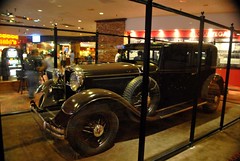
Dutch Schultz Armored Car
Dutch Schultz Armored Car (Photo credit: www78)
When he was acquitted on August 1, 1935, the crowd outside the courtroom cheered. Judge Bryant “who was visibly astonished, disappointed and thoroughly exasperated. In fact, he practically ‘lost his cool.’ ‘Your verdict,’ he declared, ‘Is such that it shakes the confidence of law-abiding citizens in integrity and truth. It will be apparent to all who followed the evidence in this case that you have reached a verdict not on the evidence but on some other reason. You will go home with the satisfaction, if it is indeed a satisfaction, that you have rendered a blow against law enforcement and given aid and encouragement to people who would flout the law. In all probability they will commend you. I cannot!’” (Franklin County Review, vol 12, pg. 27).

Schultz tried to shake hands with the jurors. The first he tried said, “Mr. Schultz, I wouldn’t shake hands with you under any circumstances—especially here!” (Franklin County Review, Vol 12, pg. 27).

But the jury felt the government hadn't proved its case despite having called sixty-nine witnesses to the defense's seventeen.

Perhaps the biggest blow to the prosecution was that “Judge Bryant, at the request of the defense staff, ruled that the famous black ledger containing all the incriminating details of the Schultz organization’s operations had been illegally seized and directed that it be returned. The ledger being the core of their case the Government lawyers were stymied and practically futile without it” ( Franklin Historical review, vol. 12, 1975, p.26 ). This ledger had been meticulously kept, down to the penny, and in impeccable penmanship.

Then during the trial, defense attorney George Moore proclaimed, “the beer business was a hazardous business—our local bootlegger never made much money.”  (Kill the Dutchman by Paul Sann pg. 253).

The above obviously played into the acquittal. Foreman Chapin said, “I am sure that no man on the jury approves of racketeering or anyone connected with it. In fact the jury considers Schultz to be a public enemy. But the fact that he was a racketeer and in the beer business could have no bearing on the case. We felt that the Government did not prove its case. The whole discussion centered around whether or  not he was guilty of willfully evading tax payments We were instructed to follow the evidence that that’s what he did. Pre-trial influence had no bearing whatsoever on the verdict, which was 9 to 3 for acquittal.”

And according to Schultz, “An easy acquittal" (ibid).

Dutch Schultz showed the same generosity to Malone after his exoneration as before his trial.

At Moore’s office, two secretaries accepted five pound boxes of chocolates (pg 27 Review). 
And according to Fredrick Seaver who wrote the quintessential historical guide to Malone, more than one farmer had new cows after the trial.

Schultz tried to shake hands with the jurors. The first he tried said, “Mr. Schultz, I wouldn’t shake hands with you under any circumstances—especially here!” ( Review, Vol 12, pg. 27).

Beyond these things, Schultz did not stay in Malone long.Knowing that Dewey still had it in for him, he set up his enterprise in Newark, New Jersey.

Shortly before his death, fearing that he would be incarcerated as a result of Dewey's efforts, Schultz commissioned the construction of a special airtight and waterproof safe, into which he placed $7 million in cash and bonds. Schultz and Rosencrantz then drove the safe to an undisclosed location somewhere in upstate New York and buried it. At the time of his death, the safe was still interred; as no evidence existed to indicate that either Schultz or Rosencrantz had ever revealed the location of the safe to anyone, the exact place where the safe was buried died with them. 

Gangland lore held that Schultz's enemies, including Lucky Luciano, spent the remainder of their lives searching for the safe. The safe has never been recovered.


Treasure hunters meet annually in the Catskills to search for the safe. One such congregation was documented in the documentary film Digging for Dutch: The Search for the Lost Treasure of Dutch Schultz” (Wikipedia).
  
Schultz was gunned down October 23, 1935 at the Palace Chop House in Newark, New Jersey.

He survived the initial shotgun blasts and was whisked into surgery. “Before Schultz went to surgery, he received the last rites from a Catholic priest at his request. During his second trial, Schultz decided to convert to Catholicism and had been studying its teachings ever since, convinced that Jesus had spared him prison time. Doctors performed surgery but were unaware of the extent of damage done to his abdominal organs by the ricocheting bullet. They were also unaware that Workman had intentionally used rust-coated bullets in an attempt to give Schultz a fatal bloodstream infection (septicemia) should he survive the gunshot. Schultz lingered for 22 hours, speaking in various states of lucidity with his wife, mother, a priest, police, and hospital staff, before dying of peritonitis” (Wikipedia)

So instead of living safely in jail and running his empire, the events in Malone, New York actually contributed to his death.


Enhanced by Zemanta

Monday, October 14, 2013

Dutch Schultz: The Malone Trial

Dutch Schultz
Dutch Schultz (Photo credit: Wikipedia)
After living as a free man for his Malone trial, Dutch Schultz was remanded to jail on July 23, 1935. For the first day, he had to endure the same food as the other prisoners. This included sardines, boiled potatoes and cabbage, tea or water--certainly not the fare we serve today. However, after the first day, Schultz could order out.

The jurors for Schultz's trial included many names still prominent in the area today:

  1. Arthur Quinn from Malone--a farmer
  2. Hollis Child from Malone--a farmer--his daughter stated her father said, "(t)he majority, seven jurors, felt that Judge Bryant brought the trial up here so he'd have a bunch of dumb farmers, and get what he wanted." (Adirondack Life,  August 1991, p. 30).
  3. Ralph E. Westcott from Malone--a farmer
  4. Hugh F. McMahon from Malone--a farmer
  5. L.P. Quinn from Tupper Lake--school superintendent
  6. Charles Bruce from Santa Clara--a manager
  7. Leon A. Chapin from Bangor--a farmer--and the foreman of the jury
  8. John Ellsworth from Ft. Covington--a farmer--the last to hold out for acquittal
  9. Arthur J. Riedel from Malone--a baker and related to the baseball commissioner
  10. Hugh Maneeley from Malone--a farmer
  11. Floyd Brown from Owls Head--a farmer
  12. Frank Lobdell from Saranac Lake--a guide
His defense team:

  1. James M. Noonan
  2. J. Richard "Dixie" Davis--“whose task was made more tolerable by the presence of a very well-endowed, red-headed show-girl name Hope Dare, who became the center of attraction and distraction in the crowded courtroom during the trial” (Franklin County Historical Review, vol 12, 1975, page 24). He eventually married and then divorced her.
  3. George Moore from Malone
  4. Robert G. "Bud" Main from Malone
The prosecution:
  1. Martin Conboy--a protege of Thomas Dewey who had vowed to get Schultz/in order to undo the travesty of his earlier trials.
  2. John Burke Jr.
The judge was a former Malone resident: Judge Frederich H. Bryant

For a while, it appeared this jury would be deadlocked. At 7:30 p.m., Aug. 1 as word leaked out of a 9-3 decision for acquittal. Later, only one juror held out against acquittal, John Ellsworth. After 28 hours and 20 minutes, the jury came back with a not-guilty verdict.

Judge Bryant “who was visibly astonished, disappointed and thoroughly exasperated. In fact, he practically ‘lost his cool.’ ‘Your verdict,’ he declared, ‘Is such that it shakes the confidence of law-abiding citizens in integrity and truth. It will be apparent to all who followed the evidence in this case that you have reached a verdict not on the evidence but on some other reason. You will go home with the satisfaction, if it is indeed a satisfaction, that you have rendered a blow against law enforcement and given aid and encouragement to people who would flout the law. In all probability they will commend you. I cannot!’” (Franklin County Review, vol 12, pg. 27).

In the answer to last week's quiz, the Rev. John R. Williams, the pastor of the First Congregational Church, made the national news as he spoke out against Schultz. He said, “the tendency of certain humans to desert spiritual for material gains” (p. 25 Franklin Historical Review, vol 12, 1975), he found it deplorable “that men in high places would fawn over gangsters and that communities would hail them with rejoicing because their arrival meant money.” (Kill the Dutchman, p. 245)

Quiz: How did Schultz's win turn out to be his loss?

Next week: the fallout from the trial


Enhanced by Zemanta

Monday, October 7, 2013

The Dutch Schultz and Malone: Part 1

Prohibition ended in 1933, but Malone's last hurrah with it came in the summer of 1935 when the gangster Dutch Schultz came to town.

Schultz, whose real name was Arthur Flegenheimer, made his fortune bootlegging. He dodged $92,000 in taxes on $481,000 income. He said he was told he didn’t have to pay taxes on it because it was illegal income.

Judge Bryant, a native of Malone, decided to take him to his home town because he believed Schultz could be convicted. Unfortunately, the jurors disagreed. According to Jean Child, daughter of one of the jurors, Hollis Child, "(t)he majority, seven jurors, felt that Judge Bryant brought the trial up here so he'd have a bunch of dumb farmers, and get what he wanted." (Adirondack Life,  August 1991, p. 30).

In July, members of Schultz's mob began migrating to Malone. They took up residence in the Flanagan Hotel--a suite of rooms on the fourth floor for Schultz, the first floor for the defense team which included local lawyer, Bud Main. Immediately the gangsters began to buy the town.

Schultz arrived on July 17, 1935 with his chauffeur and body-guard, Lulu Rosencrantz.

He played up his role as a wonderful, misunderstood man by making sure:

  1. People knew he served as a deputy sheriff at Long Lake. He had, at one time, for about six months.
  2. Was seen with locals such as Harold Main and Mayor Ralph Cardinal
  3. He went horseback riding with Main's son Robert. There were stables behind his house on Elm St.Young Main and Schultz would ride along a bridle path by the Salmon River.
  4. He'd pick up tabs for everyone in bars such as the Hillview and other nightspots.
  5. He'd leave $100 tips in restaurants.
  6. He'd buy new jerseys for our baseball teams. At this time we had a semi-pro team named the Stars that appeared to play at the Fairgrounds. Schultz shared Mayor Cardinal's box seat.
  7. He'd bring toys to children
And the town loved him, seeing him solely as a man on trial for tax evasion. Even though he was known as a bootlegger, most people, especially near the end of Prohibition, had made and/or sold their own liquor, so they saw Schultz as just a regular guy.

He dressed well. Was mild-mannered. And if he was so bad, why was he only being tried on tax evasion--especially as he had tried to pay the back taxes?

On July 23, 1935, his bail was revoked the trial began.

Answers to last weeks quiz: Who were the two gangsters in the North Country? Obviously, Dutch Schultz in Malone. The other was in Saranac Lake--Legs Diamond.

Next quiz: Which local person made national headlines speaking against Schultz and Malone's buyout?

Enhanced by Zemanta

Monday, September 30, 2013

Bootlegging Buffoonery

1931 Packard 833 photographed in Montreal, Que...
1931 Packard 833: it'd be a shame to
shoot up this beauty.
Information for this article was found in: Mooney, Elizabeth C. "War on Rum Road." Adirondack Life. November 1980.

Buffoonery in Rumrunning? Yes, some of the things people did in the name of booze was quite funny. And there were no shortages of risk takers seeing as $240 in Canadian hootch netted the running $700 in NYC. A quite handsome Canadian exchange!

Getting to Canada, in those days, was quite easy...head to a neighbor's farm and drive over the back pasture. Voila. Load up your Packard and head on down to the Big Apple.

But what if a revenuer or Malone's Black Horse caught on to you?

  1. through the lever on the dashboard and lay down a smoke-screen. OR
  2. press the air compressor throttle and throw up dust. OR
  3. lay down an oil slick. OR
  4. aim for the prohi (fed) OR
if all else failed, go low tech--toss out the nails and broken glass you stored on the passenger seat. That would flatten any tire.

Fortunately for the bootleggers--the troopers didn't have cars in the early years. Your nemesis road a horse and Troop B of the NY State Police was known as the Black Horse Troop. They patrolled the border in pairs. The Captain of these troopers only had a general idea where their officers were. The bootleggers, via their underground network, knew to a man, where they hid.

Synonyms for the Black Horse Troop:
  • dressed up Boy Scouts
  • Map showing Rouses Point, New York
    Map showing Rouses Point, New York (Photo credit: Wikipedia)
  • gun-toting tin soldiers
What happened when a roadblock netted a bad guy?

The car was put up for auction, and guess who usually bought it? At least the troopers got some revenue.
How'd the revenuers get rid of the booze?
  • In Rouses Point they tried flushing it down the toilet. But like today, flushing stuff not supposed to go in the sewer had dire consequences. The sewer line burst. It's said the railroad tracks in Rouses Point ran with rum.
  • "Whiskey Gully" (my name) on Webster St.
  • In Malone, uncorroborated reports say Canadian whiskey was dumped on Webster St. About a mile up from Route 11 a gully tuns down toward what is now Wilcox St. and the Rec Park. Supposedly lots of booze got jettisoned there. (I think it's time for a walk to look for some wayward bottles. Should be appropriately aged by now).
And I'll close with a quiz:
Who was the beer baron associated with Saranac Lake?
Who was the beer baron known in Malone?

The answers next week.

Enhanced by Zemanta